 Nowen
NowenA user-generated business concept from Nowen — not an existing product.
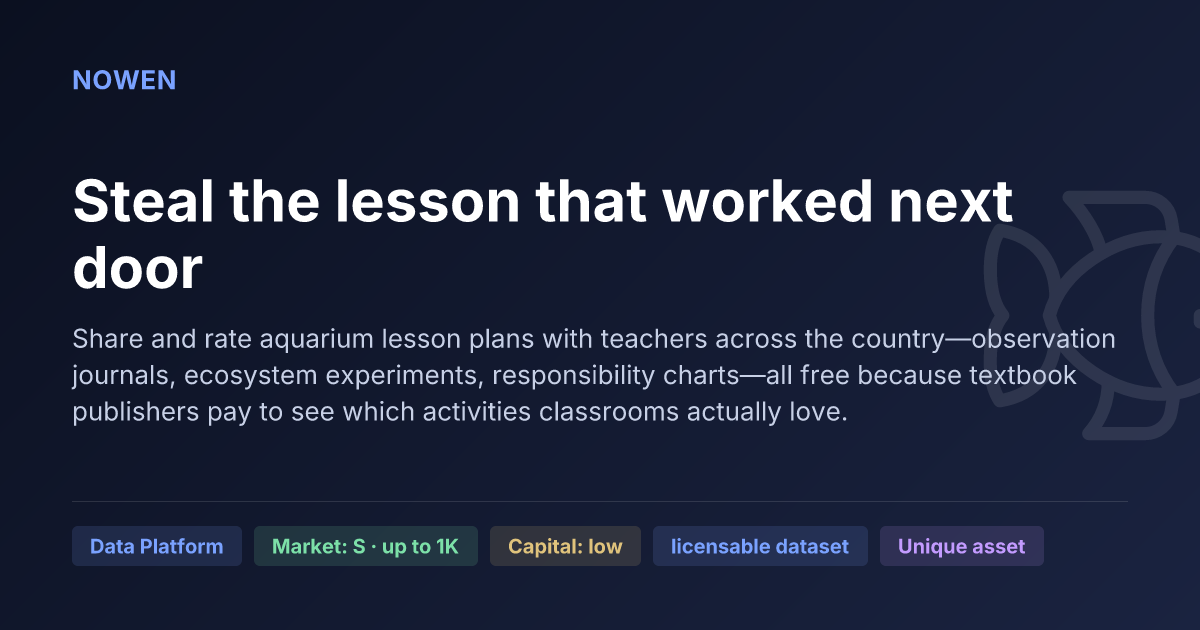
Share and rate aquarium lesson plans with teachers across the country—observation journals, ecosystem experiments, responsibility charts—all free because textbook publishers pay to see which activities classrooms actually love.
Great classroom ideas shouldn't stay inside one classroom.
How it works
Teachers upload and rate aquarium-based lesson plans (observation journals, ecosystem experiments) on a free platform. The anonymized usage data — which activities are downloaded, by which grade levels, mapped to which standards — is licensed to education publishers to inform curriculum development.
Story
For elementary teachers, who want fresh science activities but don't have time to invent them, the platform lets them share and rate aquarium-based lesson plans (observation journals, ecosystem experiments, responsibility charts), free because the anonymized dataset of what teachers actually use gets licensed to textbook publishers.
Payer
Education publishers (Scholastic, McGraw-Hill, Pearson) pay $15K–25K per year for anonymized usage data (which activities are most downloaded, which grade levels, which standards they map to) to inform their own curriculum development.
Asset
Classroom-tested lesson plan data + teacher engagement + trust (rankings based on peer use, not payment).
Revenue potential
We estimate only five reachable buyers: the major K-12 education publishers in North America (Scholastic, McGraw-Hill, Pearson, Houghton Mifflin Harcourt, and perhaps one or two others) who might license aquarium-specific lesson-plan usage data. The annual price of twenty thousand dollars per publisher is set at the midpoint of the original fifteen to twenty-five thousand dollar range. Market penetration is conservatively modeled at twenty, forty, and sixty percent, reflecting high uncertainty about whether any publisher values narrow topic datasets versus broader curriculum analytics. We assume full capture of what each publisher would spend on this specific data since no substitute aquarium-activity datasets are evident, though the entire premise remains unvalidated by the evidence.
Competition Open space
The search evidence reveals no direct competitors in aquarium-specific lesson-plan sharing or dataset licensing. However, it also provides zero validation that education publishers pay for topic-specific (aquarium) usage data, or that such a narrow vertical can sustain a licensing business. The open landscape likely signals lack of market demand rather than greenfield opportunity.
Wedge
No defensible wedge exists. The evidence shows no real incumbents focused on aquarium lesson-plan sharing or dataset licensing to publishers. However, this openness reflects absence of demand rather than opportunity: general educator platforms (Teachers Pay Teachers, ShareMyLesson) could trivially add aquarium content if publishers valued it, and no evidence suggests publishers pay for narrow, topic-specific usage data versus broader curriculum analytics. The idea assumes publisher demand that is unvalidated.
Industry
K-12 Education & Science
Not shown in this preview
This public profile never discloses this idea's durable roadmap, its value-leverage analysis (whether it delivers disproportionate value for the cost of delivering it), or its distribution strategy (the route to its first 100 users) — claim or copy the idea into your own account to unlock them.
Claiming transfers the whole conversation — every idea — to your account; the author's personal description, Advisor chat, and version history are not included.
Related Ideas
Every spawn, every parameter—proof in the water
Log every tank parameter and spawn in one free app, then watch patterns emerge across your whole operation. Serious breeders earn verified badges that buyers trust, while fish food makers learn what actually keeps fry thriving.
Bring the reef into your classroom
Teach life cycles, ecosystems, and responsibility with week-by-week aquarium lesson plans built by teachers like you. Aquarium suppliers sponsor the whole platform so their starter kits reach thousands of classrooms—and you get it free.
Stop Googling. Ask a breeder who's done it.
Book a live video session with an expert breeder who's already raised the species you're struggling with. Beginners pay per session for real answers, and you get personalized help instead of conflicting forum threads.
The hobbyist vote: what actually works
Vote head-to-head on care tips—this food versus that one, this filter versus that—so the community surfaces what really works. It's free for you; manufacturers pay to learn which products win your trust.
Sources
- Ready-made aquarium lessons for your classroom - Nowen
A user-generated concept on Nowen, not an existing product or competitor.
- Resources for Educators Using Data in the Classroom
Resources for educators using data in classrooms; no aquarium lesson-plan or licensing info.
- Summer Swap: Top Time-Saving EdTech Tools for K12 ...
YouTube video on K12 EdTech tools; no aquarium curriculum or data licensing content.